A City Born from the Vision of a King Who Looked Beyond His Time.
Most people believe Jaipur was built simply because Amber had become overcrowded or faced a growing shortage of water. While these challenges certainly influenced the decision, they tell only part of the story.
The true inspiration behind Jaipur was Sawai Jai Singh II — a remarkable ruler, scholar, astronomer, and visionary whose ambitions extended far beyond building another royal capital.
The title "Sawai," meaning "one and a quarter" (or 1¼ times greater than an ordinary man), was bestowed upon him in recognition of his exceptional intellect and abilities.
Unlike many kings of his time, Jai Singh II was deeply fascinated by science, mathematics, architecture, astronomy, and urban planning. He dreamed of creating a city that would not only serve as the new capital of his kingdom but also become a centre of learning, trade, innovation, and scientific exploration.
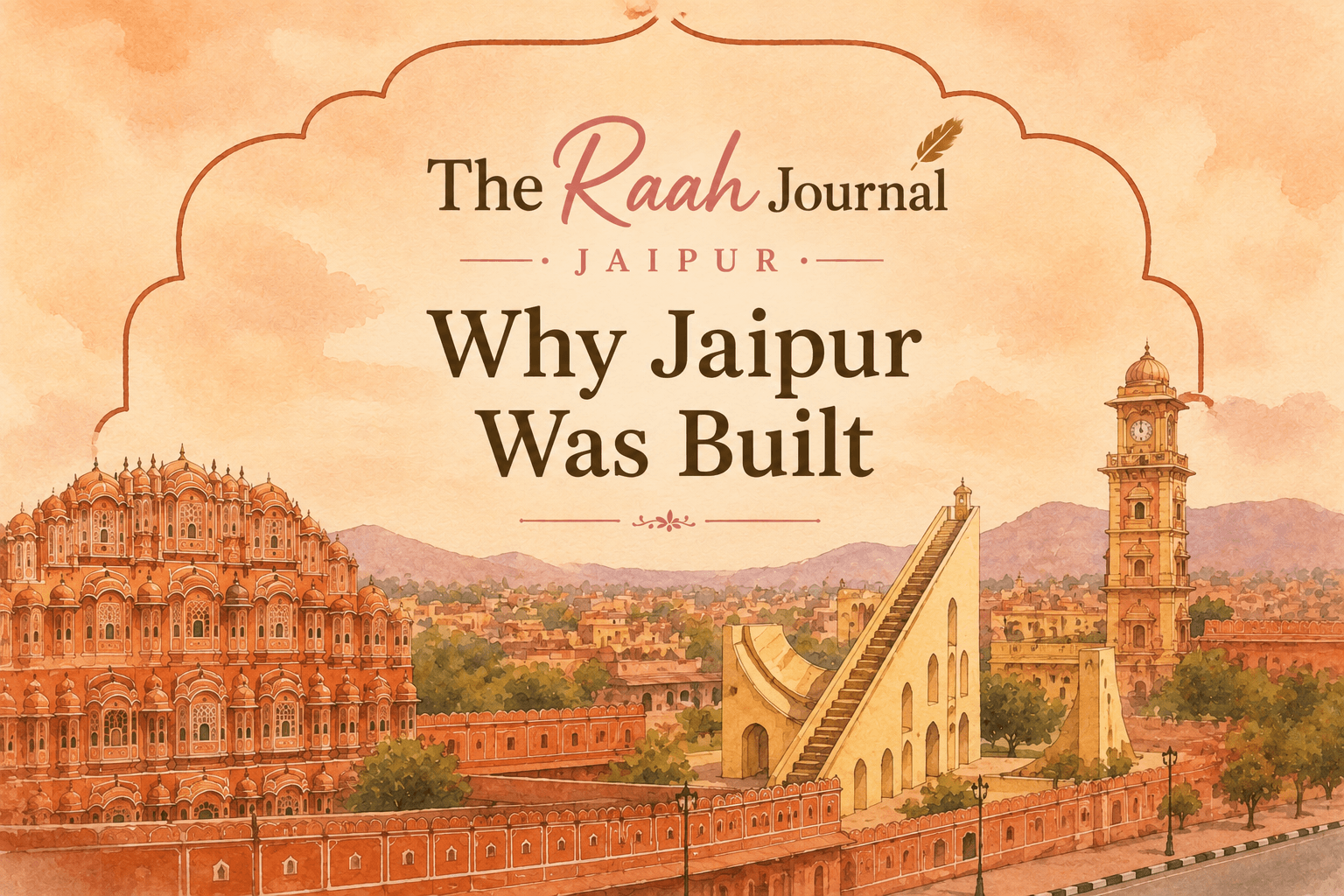
His greatest passion was astronomy. Unsatisfied with the inaccuracies of existing astronomical tables, he commissioned the construction of five astronomical observatories — known today as the Jantar Mantars — in Delhi, Jaipur, Ujjain, Varanasi, and Mathura. These monumental instruments reflected his relentless pursuit of precision.
Jaipur became the canvas upon which he brought all these ideas together. Designed according to the ancient principles of Vastu Shastra and planned on a rational grid unlike any other Indian city of its time, Jaipur was conceived as a city where science, commerce, governance, culture, and spirituality could coexist in perfect harmony.
More than three centuries later, Jaipur continues to embody the vision of the extraordinary king who dared to imagine a city a century ahead of its time.
Jaipur was never built simply to replace Amber. It was built to realise the vision of a ruler who believed that knowledge, planning, and progress could shape the future of an entire kingdom.
The story of Sawai Jai Singh II's vision comes alive on The Crown of Jaipur, which connects Hawa Mahal, Jantar Mantar and City Palace.
— The Raah Journal, Jaipur