Amber Fort is the first thing most travellers want to see in Jaipur, and for good reason. Its honey-coloured walls rise above Maota Lake on the edge of the Aravalli Hills, and inside are some of the most beautiful palace rooms in India.
I walk up to Amber with travellers almost every week, and I still find something new each time. In this guide I will explain what the fort is, what to see inside, the old town most visitors miss, and how to plan your visit so you see it at its best.
Amber Fort or Amer Fort: Are They the Same?
Yes. Amber and Amer are two spellings of the same place. The fort, the palace inside it and the town below all take their name from Amer. You will see both spellings on signs, maps and tickets, and both are correct. The fort is about 11 km from Jaipur's old city.
A Short History of Amber Fort
Long before Jaipur existed, Amer was the capital of the Kachhawaha Rajputs. The palace we see today was begun by Raja Man Singh I at the end of the 16th century, and later rulers kept adding to it, including Mirza Raja Jai Singh I and Sawai Jai Singh II.
In 1727, Sawai Jai Singh II moved the capital down to the plains and founded Jaipur. Amber stayed behind as a royal fort and, together with other hill forts of Rajasthan, is now a UNESCO World Heritage Site.
What to See Inside Amber Fort
Jaleb Chowk and Sila Devi Temple
You enter the fort through Suraj Pol, the Sun Gate, into Jaleb Chowk, the large courtyard where soldiers once gathered. Just off it is the Sila Devi Temple, dedicated to the family goddess of the Kachhawaha kings.
Diwan-i-Aam
The Hall of Public Audience, with its double row of columns, is where the king met his subjects and heard their petitions.
Ganesh Pol
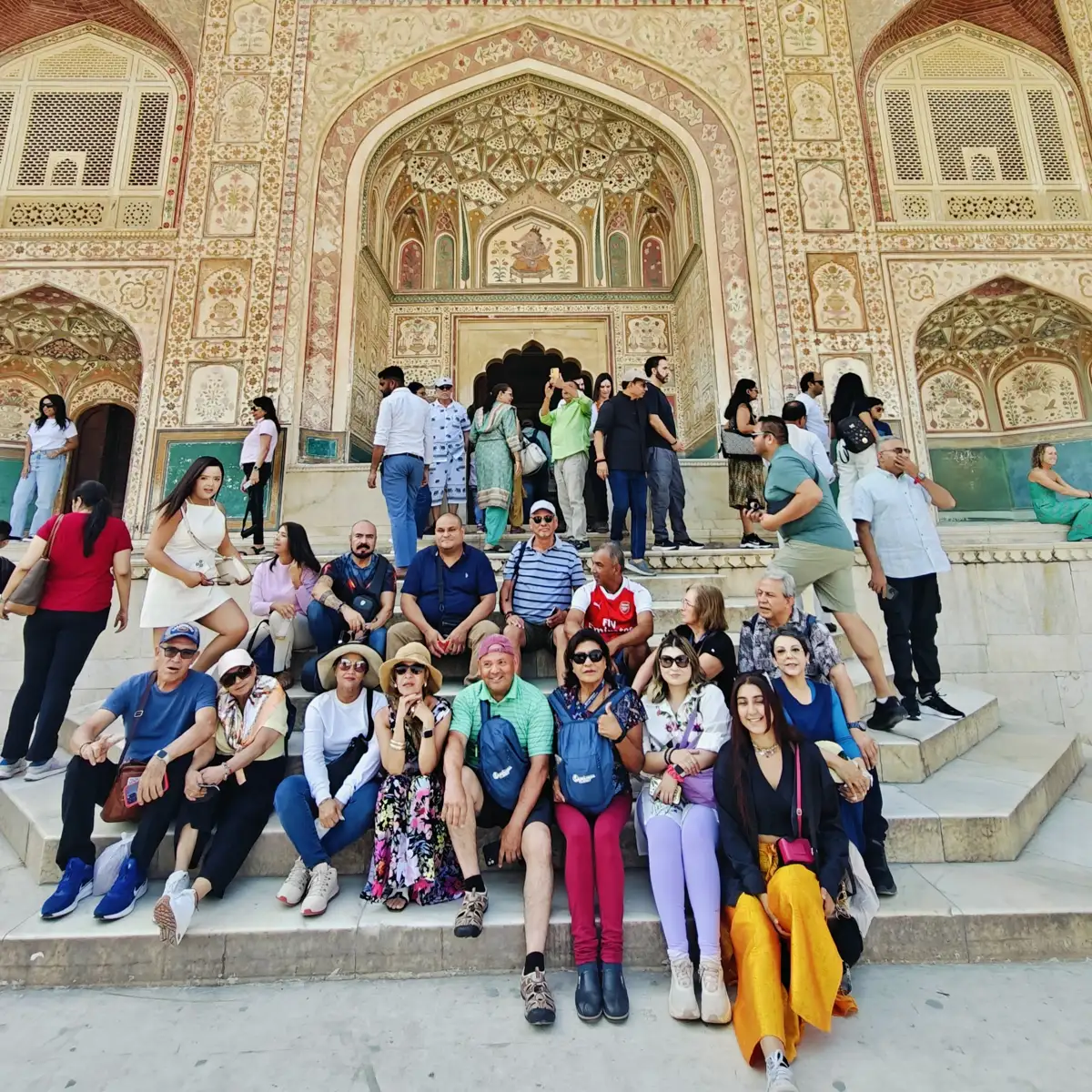
The most photographed gateway in the fort, covered in painted patterns, with a figure of Lord Ganesh above the arch. It leads into the private apartments of the king.
Sheesh Mahal
The Hall of Mirrors is the highlight of Amber. Its walls and ceiling are covered in thousands of small pieces of mirror and glass. It is said that the light of a single candle was enough to make the whole room sparkle.
Sukh Niwas
Opposite the Sheesh Mahal, the Sukh Niwas was designed to stay cool in the desert heat. Water once ran through channels in the floor, and breezes passing over it cooled the rooms.
The Palace of Man Singh I
The oldest part of the fort, built around a central pavilion and surrounded by the apartments of the royal women. It is quieter than the rest of the fort and easy to miss.
Maota Lake and Kesar Kyari
Below the fort, Maota Lake reflects the walls in still water. In the middle of the lake is Kesar Kyari, a geometric garden that, according to tradition, was once planted with saffron.
Beyond the Fort: The Old Town of Amer
Most visitors drive up to the fort, take their photos and leave. Below it is the old town of Amer, which I think is the most rewarding part of a visit.
- Jagat Shiromani Temple: a 16th-century temple with a carved white marble gateway and a beautiful shikhara.
- Panna Meena ka Kund: a stepwell with criss-cross stairs on all sides, one of the most photographed places in Jaipur.
- Ambikeshwar Temple: believed to be around 5,000 years old, built in the Nagara style on 14 pillars, with Lord Shiva in rock form 22 feet below ground level. In the monsoon, when the groundwater rises, the shrine is submerged, a natural "jalabhishek" of the deity.
Read more: Hidden Temples of Amber: 5 Temples to See.
The Tunnel to Jaigarh Fort
Amber Fort is connected to Jaigarh Fort on the hill above it by a long fortified passage that was reserved for the royal family. Jaigarh was the kingdom's cannon foundry and is home to the Jaivana, cast in 1720. Its foundation is attributed to Raja Kakil Dev in the 12th century.
Read more: Why Jaigarh Fort Was Never Conquered and Amer vs Jaigarh vs Nahargarh: which fort to visit.
The Ridge & Ramparts is our morning walk from Amber town, past Jagat Shiromani and the stepwells, up to Jaigarh and the Jaivana cannon.
Best Time to Visit Amber Fort
- Time of day: go early. Avoid the midday hours and late evening. Amber is at its best in the morning, though it is busy then too, so arrive as early as you can.
- Time of year: October to March is the most comfortable. From April to June it is very hot, so go as early as possible. See our guide to the best time to visit Jaipur.
- How long: plan two to three hours for the fort, and another hour or two if you want to explore Amer town.
- Tickets: Amber Fort is included in Jaipur's composite ticket, along with several other monuments. Check current timings and prices on the official Rajasthan Tourism website before you go.
How to Get to Amber Fort
Amber is about 11 km north of the old city, a 20 to 30 minute drive depending on traffic. You can take a taxi, Uber or Ola, or a tuk-tuk. From the parking area below the fort, you can walk up the ramp to Suraj Pol, which takes about 15 minutes.
The Light and Sound Show at Amber Fort
In the evening, the walls of Amber are lit in changing colours while the show tells the story of the fort and its rulers. The English show starts at 6:30 PM from October to February, 7:00 PM in March and April, and 7:30 PM from May to September, with a Hindi show an hour later. Timings can change, so check before you go.
Read more: Things to do in Jaipur at night. The Blue Hour includes a glimpse of the show on its evening drive.
Visit Amber Fort With a Local Guide
Amber is big, and without someone to explain it, many visitors walk through the most important rooms without knowing what they are looking at. All Raah experiences are led by a licensed local guide, in English or Spanish, in small groups. For more ideas across the city, see our complete guide to things to do in Jaipur.
Reading in Spanish? Here is our guía completa del Fuerte Amber.
Frequently Asked Questions
From Our Guests
— The Raah Journal, Jaipur